Relational Dexterity: Transferring Human Dexterity via Relational Geometric Prior
Abstract
While large-scale human demonstrations provide valuable guidance for learning dexterous manipulation, transferring these skills to robotic hands remains challenging due to the inherent embodiment gap between human and robot morphologies. Existing methods typically rely on absolute keypoint representations that discard fine-grained finger synergies, and employ explicit kinematic retargeting to accelerate the learning process, which can induce kinematic inconsistency and physical conflicts.
We propose ReDex, a framework that shifts the focus from absolute spatial tracking to intrinsic interaction geometry. ReDex first extracts relational manipulation vectors from human data and compresses them into a smooth latent space, establishing a unified geometric prior that is invariant across embodiments and capture hand synergies. Guided by this prior, we introduce a curriculum reinforcement learning strategy with a state pool constrained by the latent space for episode initialization, which confines exploration to physically valid, human-like motion manifolds and stabilizes policy learning. Extensive experiments demonstrate that ReDex consistently outperforms current state-of-the-art methods across diverse manipulation modes, with robust cross-embodiment transfer and real-world feasibility.
Method
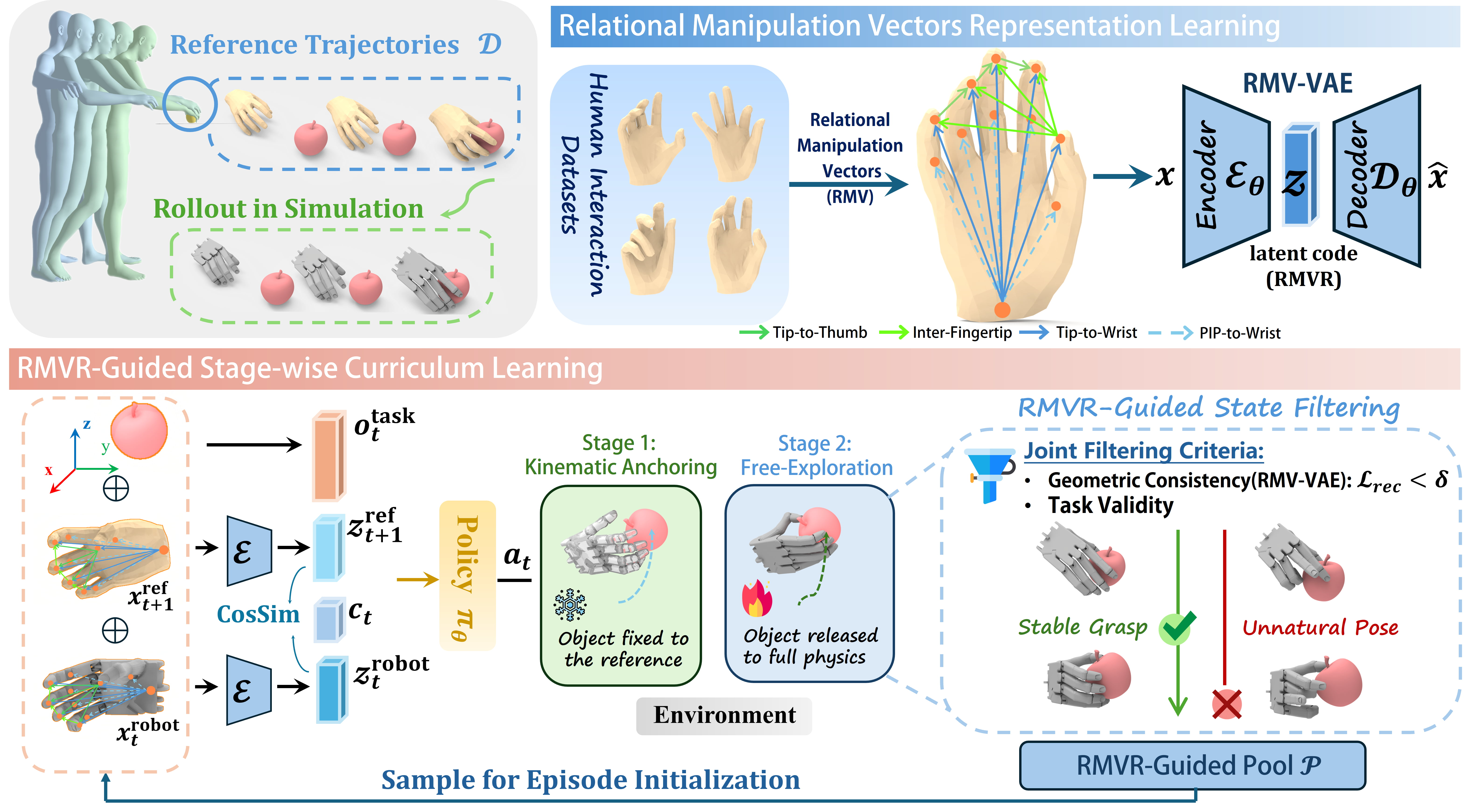
Overview of our ReDex framework. ReDex extracts RMVs from human demonstrations to model human-like synergistic priors (RMVR) via the RMV-VAE. These priors guide a stage-wise curriculum to train a dexterous policy, utilizing an RMVR-guided state pool to initialize training episodes strictly with geometrically valid and physically stable poses.
BibTeX
@inproceedings{chen2026relational,
  title={Relational Dexterity: Transferring Human Dexterity via Relational Geometric Prior},
  author={Chen, Jiaying and Zhang, Bingheng and Liu, Qingtao and Ge, Yiyang and Ouyang, Wenzhe and Chen, Anjun and Ye, Qi},
  booktitle={IEEE/RSJ International Conference on Intelligent Robots and Systems (IROS)},
  year={2026}
}